Earth’s overpopulation crisis
The Caves of SteelEarth’s overpopulation crisis is the structural pressure beneath the novel’s conflict over Cities, robots, and migration: the urban system has made life possible for billions, yet its growing dependence on continuous supplies leaves it less able to withstand disruption. The crisis is not simply a question of crowded housing. It links food production, energy, transport, social rank, and the blocked movement of people between Earth and the Outer Worlds, making the order that sustains Earth also a source of mounting risk.
Population Pressure and the Rise of the Cities
The novel describes a demographic threshold at which gradual improvements could no longer answer the scale of Earth’s population. Earlier settlements were open-air clusters distributed across the planet, from small communities to centers that rarely reached ten million. As population rose from two or three billion toward five billion, Earth could still support more people by lowering living standards; at eight billion, however, the prospect of semistarvation made that adjustment untenable. The Outer Worlds’ severe immigration restrictions compounded the pressure: Earth could not rely on its former colonies as an outlet for its population.
The response was a thousand-year transformation in settlement and economic organization. Villages, towns, and the older open cities were absorbed into enormous Cities, where efficiency depended on scale and shared services. Instead of duplicating kitchens and bathrooms in every dwelling, residents used communal diners and shower rooms. The shift replaced dispersed local life with a system organized around consolidated production and distribution; it was presented not as a freely reversible preference, but as the means by which Earth could continue supporting its population.
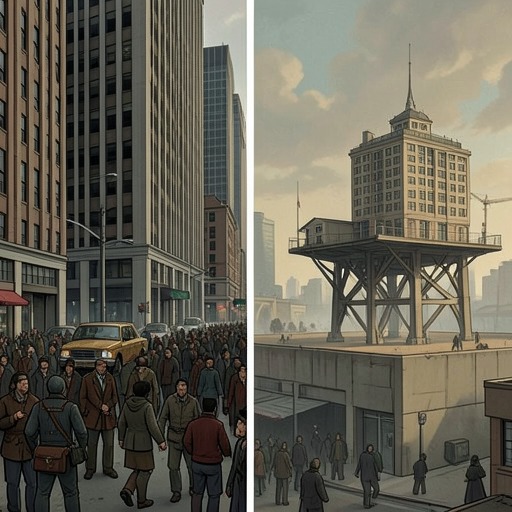
By the period of the story, New York City extended across more than two thousand square miles and had a population well above twenty million. Earth had about eight hundred Cities, averaging ten million inhabitants each. New York was therefore neither a small urban center nor an isolated exception: it exemplified a planetary settlement pattern built to concentrate people and resources on a vast scale.
The City as a Lifeline and a Fragile System
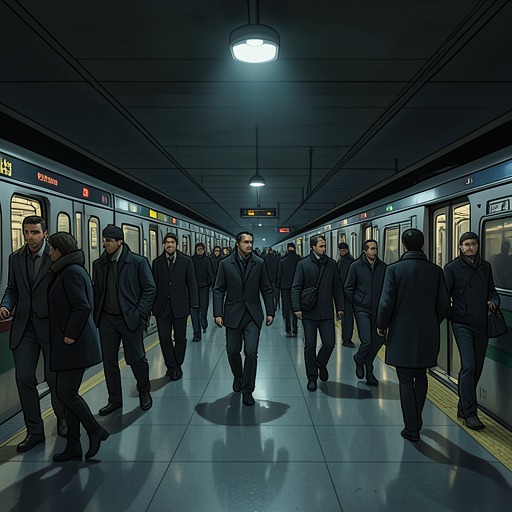
Each City was semiautonomous and nearly self-sufficient in economic organization, but its apparent independence rested on a comprehensive engineered environment. It could roof itself, surround itself, and extend its infrastructure underground. Administrative offices occupied the center; residential Sections were linked by expressways and local ways; factories, hydroponic plants, yeast vats, and power plants lay toward the outskirts. Water pipes, sewage ducts, schools, prisons, shops, power lines, and communications systems threaded through the whole. This arrangement concentrated essential functions inside a vast enclosure, making the City an instrument for managing population as well as a habitat.
Food provision depended on coordinated systems rather than on nearby farms alone. City culture meant distributing food efficiently and increasing the use of yeast and hydroponics. Yet this achievement did not resolve the demographic problem: Earth’s population continued to rise, and even the Cities’ productive capacity could not prevent the calories available per person from eventually falling below basic subsistence. The crisis thus emerges as a limit on the very solution developed to contain it. Greater organization buys time, but does not abolish the pressure.
The City’s self-sufficiency is also qualified by its dependence on uninterrupted flows. New York must continually bring in water and carry waste away; its nuclear power plants require uranium that is increasingly difficult to obtain, even from other planets in the system. Yeast production depends on arriving wood pulp, hydroponic agriculture on minerals, and urban life on continuous air circulation. These needs form a delicate balance across many systems, and the volume of input and outgo grows as the City grows. A disruption lasting even an hour is posed as a danger the modern City cannot safely absorb.
That vulnerability sharpens across historical comparison. Primitive population centers could rely on produce from neighboring farms, so flood, pestilence, or crop failure posed immediate but localized dangers. As technology and settlement expanded, communities could draw help from distant places, but this increased their interdependence. The largest open cities of the Medieval period could survive for at least a week on stored food and emergency supplies; New York, when it first became a City, could have sustained itself for a day. In the present, it could not do so for an hour. A disaster that once meant discomfort, and later a serious or acute emergency, has become potentially fatal. The crisis is therefore both demographic and systemic: more people depend on an urban network whose growing complexity magnifies the consequences of failure.
The Outer Worlds and the Blocked Outlet
The Outer Worlds intensify Earth’s predicament. Their inhabitants are descendants of early emigrants from Earth, but they live on underpopulated worlds where robots perform much of the work. The Spacers maintain low birth rates and keep immigrants from Earth out, protecting the comfort made possible by the emptiness of their worlds. Their immigration restrictions prevent Earth from easing its population pressure through outward movement, even as the colonies’ abundance offers a stark contrast to conditions on Earth.
The contrast also frames a dispute about what the future requires. The Medievalists reject the Cities and look toward a return to soil and natural agriculture, but the account insists that Earth cannot simply reverse history: there are too many people for such a retreat to be an adequate solution. Emigration to the Outer Worlds might relieve pressure, but it is restricted. The resulting bind is political as much as material: Earth’s inhabitants are told that the system they depend on cannot last indefinitely, while the alternative of leaving is controlled by societies that guard their own space and standard of living.
Robots, Status, and the Human Cost
Robots make the population crisis an immediate conflict over work and social security. On Earth they had long been restricted to mines and farms; only during the quarter-century since the Spacers arrived had they begun to enter the Cities. The movement of robots into urban life is therefore not merely a technological change. It threatens to displace workers in a society where status determines access to concrete advantages and where loss of standing can expose a person to severe deprivation.
The Commissioner’s account to Elijah Baley presents that process as already underway. Replacement had been happening throughout the twenty-five years since the Spacers came, and was only now reaching higher levels of employment. Baley is warned that mishandling the case could bring the loss of pension-tab booklets closer; handling it well might push that prospect far into the future. A C-6 rating would bring a rush-hour seat on the expressway, higher priority in the Section kitchens, perhaps a better apartment, and a quota ticket for Jessie to visit the Solarium levels. These benefits show how a population crisis becomes legible in everyday life: security is distributed through rank, and the fear of replacement is bound to the fear of losing accumulated privileges.
Baley’s family history makes that fear personal. His father, formerly a nuclear physicist with a rating in the City’s top percentile, was blamed for an accident at a power plant and declassified. Baley was one year old when it happened, but remembers his father’s later condition and the family’s circumstances. His father died while still declassified when Baley was eight; Baley and his two older sisters then entered the Section orphanage, since their poor uncle could not prevent it. Without status inherited from his father, Baley had to make his way through school without the advantages that might have eased his path.
The experience explains why declassification is not an abstract administrative threat. Even a person without status retains only the bare possibility of existence in the City; status supplies the ordinary comforts and shorter waits that make survival more secure. Baley’s prospect of advancement and his memory of his father’s fall meet in the same system: rank can protect a household, while economic displacement and institutional judgment can strip that protection away. The population crisis thus operates through both large-scale scarcity and intimate vulnerability.
Colonization as a Proposed Response
Dr. Han Fastolfe presents the introduction of robots on Earth as an attempt to disturb the City’s economic balance and produce a population that might leave. Baley understands the immediate consequence as the creation of displaced and declassified people; Fastolfe argues that such people could form a nucleus for colonization. His analogy is to ancient America, whose ships were fitted out with men from prisons. In his account, the City has failed the displaced person: someone with little left to lose might find worlds to gain by departing Earth.
This proposal exposes the ethical tension within the response to overpopulation. Robotization may displace individuals and weaken their security, yet the resulting pressure is treated as a possible impetus to emigration and the colonization of other worlds. Fastolfe’s argument makes the City’s capacity to protect its inhabitants look double-edged: a system that has made survival possible can also leave those it excludes with no place in its future. The novel connects demographic strain to a political choice about who bears the cost of creating an outlet for Earth’s population.
The crisis consequently structures more than the background of urban life. It links the immense scale of the Cities to their dependence on fragile supply networks, connects the Outer Worlds’ restrictions to Earth’s lack of room, and turns robots into agents of a contested economic transformation. Its force comes from the tension between necessity and precarity: the Cities were formed because earlier patterns could not support the population, but their efficiency has not stopped population growth, resource dependence, or the unequal distribution of safety.